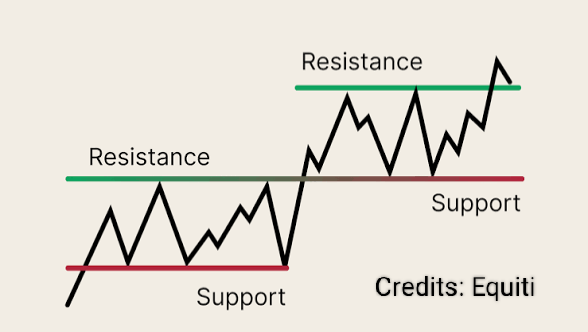
Support and Resistance
Support and Resistance are the most and widely used concepts in technical analysis. They represent key price levels or zones where the forces of supply and demand shifts. These levels help traders identify potential entry points, exit targets, stop-loss placements, and overall market direction. Understanding how they form and behave is essential for consistent risk management and decision making.
Support is a price level or zone where buying pressure is strong enough to halt a decline and push prices upward. It acts like a floor. When the price falls to this levels, demands exceeds supply, preventing further drops.
Resistance is a price level or zone where selling pressures becomes strong enough to stop a rise and push prices downward. It acts like a ceiling. When price rises to this level, supply exceeds demand, halting further gains.
Role Reversal
This is one of the important rules:
If support is broken, it often turns into New Resistance.
If resistance is broken, it often turns into New Support.
Strength of Levels
Not all levels are equal. A support or resistance zones is considered strong if:
It has been tested multiple times without breaking
High trading volume occurred at that level.
Limitations
Not guaranteed: Markets can break through levels due to news, economic data, or strong sentiment
False Breakout: Price may briefly cross a level then reverse back, trapping traders.
Less effective in extremely low liquidity or highly volatile markets.
Conclusions
Support and Resistance are the backbone of technical analysis. They reflect the colective psychology of all market participant or fear, greed, memory and expectation. While not perfect, they provide a structured way to interpret price action, improve timing and manage risk. When combined with other analysis and proper discipline, they become a powerful tool for analyzing financial market (stocks, forex, crypto, commodities, etc.).